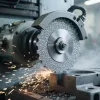
In industrial manufacturing sectors such as ceramics, glass, and stainless steel processing, the performance of grinding tools directly impacts precision and cost-efficiency. Brazed diamond grinding wheels, especially those with a 125mm diameter, are prized for their durability and sharpness in these demanding applications. Yet, the secret behind their reliable operation lies in rigorous quality management throughout the production cycle.
At the forefront of such quality assurance is the implementation of the ISO9001 standard. From the moment raw materials arrive, every step is monitored:
Such thorough protocols have measurable effects on tool longevity and operational stability.
Internal studies conducted on a large production batch of 125mm brazed diamond grinding wheels reveal:
These statistical findings underline that the incremental costs of rigorous quality control translate into a significant total cost of ownership reduction for industrial users.
Beyond product manufacturing, UHD supports clients with:
“After switching to UHD’s brazed diamond grinding wheels, our stainless steel finishing process saw a 17% increase in dimensional accuracy and a 25% decrease in defective outputs. The stability of the wheels under continuous operation has dramatically improved our line efficiency.” – Senior Engineer, European Automotive Parts Manufacturer
Get Your FREE Superhard Grinding Wheel Selection & Maintenance Guide PDF Now

 402
|
402
|
 diamond grinding wheel longevity
abrasive wheel selection guide
high-performance grinding solutions
brazed diamond wheel applications
surface finish optimization
350
|
Brazed diamond grinding tool maintenance
Brazed diamond tool service life
Industrial grinding tool selection
Customized brazed tool design
Industrial processing efficiency improvement
35
|
brazed diamond grinding tools
CE certification
vacuum brazing technology
eco-friendly grinding tools
metalworking cutting tools
467
|
brazed diamond grinding disc quality control
diamond grinding disc lifespan improvement
ISO9001 superhard tool manufacturing
grinding disc performance optimization
industrial abrasive tool inspection
311
|
Brazed diamond grinding wheels
Wear resistance improvement
Impact - resistant grinding wheel technology
Gray cast iron processing solutions
Super - hard abrasive tool selection guide
diamond grinding wheel longevity
abrasive wheel selection guide
high-performance grinding solutions
brazed diamond wheel applications
surface finish optimization
350
|
Brazed diamond grinding tool maintenance
Brazed diamond tool service life
Industrial grinding tool selection
Customized brazed tool design
Industrial processing efficiency improvement
35
|
brazed diamond grinding tools
CE certification
vacuum brazing technology
eco-friendly grinding tools
metalworking cutting tools
467
|
brazed diamond grinding disc quality control
diamond grinding disc lifespan improvement
ISO9001 superhard tool manufacturing
grinding disc performance optimization
industrial abrasive tool inspection
311
|
Brazed diamond grinding wheels
Wear resistance improvement
Impact - resistant grinding wheel technology
Gray cast iron processing solutions
Super - hard abrasive tool selection guide