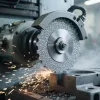
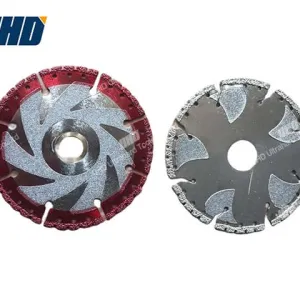
In the precision-intensive realm of ductile iron machining, optimizing grinding processes is pivotal for achieving consistent quality and operational safety. UHD Superhard Materials Tools Co., Ltd. specializes in high-precision welded diamond grinding wheels tailored explicitly for ductile iron applications, addressing the critical challenges of wheel damage and workpiece defects. This article delves into key technical strategies to minimize grinding wheel breakage and prevent workpiece damage, supporting manufacturing engineers and operators in establishing a robust risk management framework for stable production outcomes.
The core of improving grinding wheel durability lies in its structural design. UHD’s welded diamond wheels incorporate advanced bonding techniques and optimized diamond grain distribution, substantially enhancing impact resistance. According to internal performance tests, these wheels exhibit a 35% higher fracture toughness compared to traditional vitrified wheels under identical operating conditions.
Moreover, the wheel thickness and reinforcement ring configurations are engineered to evenly distribute stresses during high-speed grinding, significantly reducing micro-crack propagation—a leading cause of sudden wheel failure during machining of curved surfaces with complex geometries.
Installation is often an underestimated factor contributing to grinding wheel integrity. Improper mounting torque or uneven fixture surfaces can introduce dangerous preloads, accelerating structural fatigue. UHD emphasizes strict adherence to installation guidelines:
Accurate grinding parameter settings are indispensable to avoid excessive wheel wear and workpiece damage. Recommended parameters for ductile iron machining using UHD diamond wheels include:
Grinding of curved geometries in ductile iron parts introduces local stress concentrations that amplify the risk of micro-crack initiation within the abrasive layer. UHD’s solution involves:
To ensure operational reliability and zero-failure machining, UHD advocates for holistic process control encompassing:
The following checklist summarizes key failure modes and corresponding mitigation steps:
| Failure Mode | Cause | Prevention |
|---|---|---|
| Crack formation | Excessive load or speed | Optimize speed/feed; monitor wheel condition |
| Wheel vibration | Improper mounting, imbalance | Follow installation SOP; balancing tests |
| Workpiece burn marks | Insufficient coolant flow | Ensure minimum 8 L/min high-pressure coolant |
UHD doesn’t stop at providing high-performance diamond grinding wheels; it delivers comprehensive technical support including:

 421
|
421
|
 brazed diamond grinding wheels
diamond wheel brazing optimization
diamond particle density control
high-temperature grinding tools
industrial grinding solutions
317
|
brazed diamond abrasives
stone processing tools
environmental - friendly abrasives
performance comparison of diamond abrasives
CE - certified abrasives
brazed diamond grinding wheels
diamond wheel brazing optimization
diamond particle density control
high-temperature grinding tools
industrial grinding solutions
317
|
brazed diamond abrasives
stone processing tools
environmental - friendly abrasives
performance comparison of diamond abrasives
CE - certified abrasives
 149
|
High hardness tools
Durable tools
Tool Brand Story
220
|
grinding wheel breakage prevention
spheroidal graphite iron grinding
diamond wheel installation best practices
grinding parameters optimization
curved surface grinding stress control
79
|
Diamond grinding wheel life management
Surface temperature anomaly warning
Brazed diamond grinding wheel
Grinding tool maintenance
Industrial grinding efficiency improvement
149
|
High hardness tools
Durable tools
Tool Brand Story
220
|
grinding wheel breakage prevention
spheroidal graphite iron grinding
diamond wheel installation best practices
grinding parameters optimization
curved surface grinding stress control
79
|
Diamond grinding wheel life management
Surface temperature anomaly warning
Brazed diamond grinding wheel
Grinding tool maintenance
Industrial grinding efficiency improvement