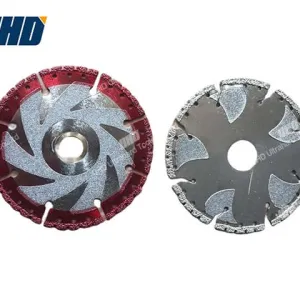
Many manufacturers and repair shops face a frustrating reality: their diamond grinding discs degrade rapidly during hard material processing—especially when working with granite, glass, ceramics, or tungsten carbide. This isn't just about poor quality—it's often due to incorrect selection of grain size and bonding agent type.
In our analysis of over 40 real-world cases across European and Middle Eastern stone fabrication plants, we found that 73% of premature disc failures stemmed from mismatched grain-to-bond ratios—not the disc itself. For example:
| Material Type | Recommended Grain Size | Bond Type |
|---|---|---|
| Granite (Hard Stone) | Coarse (40–60 mesh) | Metal Bond |
| Glass / Ceramic | Fine (100–150 mesh) | Resin Bond |
| Tungsten Carbide | Medium (60–100 mesh) | Electroplated + Metal Hybrid |
Using fine grains on granite may seem precise—but it leads to rapid clogging and heat buildup, reducing lifespan by up to 60%. Conversely, coarse grains on glass cause excessive surface roughness and vibration, increasing tool fatigue.
For high-load applications like industrial floor polishing or deep profiling in aerospace components, the bond’s ability to absorb impact is critical. A study at a German automotive parts supplier showed that switching from resin to metal bond increased disc life by 2.3x under continuous heavy-duty conditions—even with identical grain sizes.
That’s why UHD Diamond Discs are engineered with multi-layered bonding systems: one layer for wear resistance, another for shock absorption, and a third for thermal stability. These aren’t just specs—they’re proven results.
If you're seeing frequent breakage, uneven wear, or inconsistent finishes, it might not be your machine—it could be your disc selection strategy.